The agent-native VCS
Write way more code on the same quota — or cut API cost.
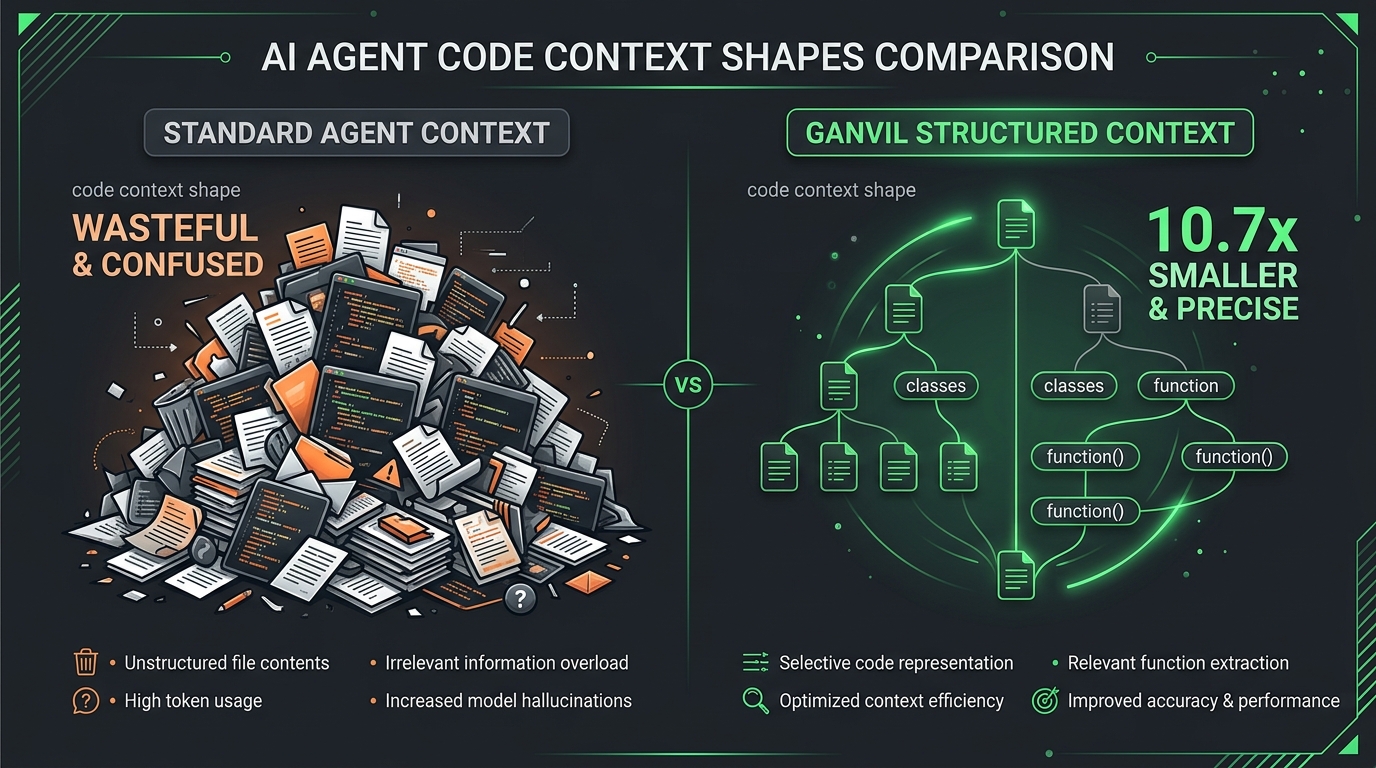
Coding agents burn a huge share of every turn re-reading the repo: full files, grep hits, rebuild context. Ganvil’s MCP hands them structured answers—outlines, symbols, ranked packs—so input context drops on the order of ~4× (about 75% less) vs dump+grep on the paths we measure. The result: you get way more code written per plan quota, or the same work at lower API cost—because less of every turn is spent paying to re-read the tree.
Pillars
~4× less input context → more code per quota, or lower API bills
Stop spending most of a turn re-reading the tree. Agents get outlines, symbols, and ranked packs instead of whole-file dumps.
- ▸Measured gather paths cut input context on the order of ~4× (≈75% less) vs dump+grep—not a wall-clock codegen SLA.
- ▸Compact outlines (e.g. ~1.7k tokens) replace multi-thousand-token full-file reads when all you need is the API surface.
- ▸Symbol graph answers (callers, impact) avoid pasting every hit file into the prompt.
Hammer Server ensures our throughput guarantees by allowing parallel edits without collision lag. Multiple agents can write code to the same checkout in parallel, multiplying team output without workspace corruption or manual merge overhead.
- ▸Concurrent agent checkouts let fleets write code in parallel rather than blocking each other in line queues.
- ▸Real-time CRDT workspace merging converges edits instantly without manual git conflict-resolution cycles.
- ▸To secure our throughput guarantees, agent writes are batched and synced to GitHub in a way that won't get you throttled.
Anvil Pods provide a harness for your agent and subagents that removes local CPU, RAM, and hard drive constraints. Keep local execution nodes fully responsive while fleets of agents compile, build, and test concurrently in the cloud.
- ▸Eliminate local bottlenecks so compiling, building, or testing agent code never slows down agent fleet throughput.
- ▸Offload compute-heavy builds to cloud-hosted Anvil Pods that spin up in milliseconds for instant test execution.
- ▸Run fifty agent tasks concurrently without running out of RAM, CPU, or disk space on local worker environments.
Our Ganvil MCP intelligently decides whether you need a Hammer Server or Anvil Pod and spins them up to keep you from slowing down.
Benefit: ~75% less input context per turn means you write way more code against the same quota—or ship the same work with reduced API cost. (Savings scale with how input-heavy your sessions are.)
Install
Up and running in 10 minutes or less!
gan v0.1.1 ships as tarballs for macOS (Apple silicon) and Linux (x86_64). Every release publishes SHA256SUMS next to the artifacts — verify before you extract, the same way you'd want your auditors to.
# macOS (Apple silicon)
curl -LO https://github.com/S7-Works/ganvil/releases/download/v0.1.1/ganvil-v0.1.1-aarch64-apple-darwin.tar.gz

# Linux (x86_64)
curl -LO https://github.com/S7-Works/ganvil/releases/download/v0.1.1/ganvil-v0.1.1-x86_64-unknown-linux-gnu.tar.gz

# verify against the published checksums, then install
curl -LO https://github.com/S7-Works/ganvil/releases/download/v0.1.1/SHA256SUMS
shasum -a 256 -c --ignore-missing SHA256SUMS   # sha256sum -c on Linux
tar xzf ganvil-v0.1.1-*.tar.gz
install ganvil-v0.1.1-*/gan ganvil-v0.1.1-*/gv ~/.local/bin/
The tarball carries two binaries: gan, the CLI, and gv, its helper. Then gan import any repo and point your agent at gan mcp.
Zero Friction Setup
Plug Ganvil directly into your existing agent.
Ganvil implements the open Model Context Protocol (MCP) standard. Connecting it to Cursor, Claude Code, or any other agent client takes less than 30 seconds.
For Claude Desktop
Add the server config to the Claude Desktop application configuration file:
// ~/Library/Application Support/
// Claude/claude_desktop_config.json
{
  "mcpServers": {
    "ganvil": {
      "command": "gan",
      "args": ["mcp"]
    }
  }
}
For Claude Code
Register the server in your global tool configuration:
// ~/.code_mcp_config.json
{
  "mcpServers": {
    "ganvil": {
      "command": "gan",
      "args": ["mcp"]
    }
  }
}
For Cursor
Open Cursor Settings ➔ Features ➔ MCP, click "+ New MCP Server", and enter:
| Name | Ganvil |
| Type | command |
| Command | gan mcp |
Your VCS is the knowledge graph. No sidecar indexer.
Sidecar graph tools proved the demand, then went stale between runs. Ganvil makes the graph a property of the repository — incremental, versioned, and queryable at any commit.